Maximise Security and Performance with Self-Hosted Feature Flags
Keep your feature flag data in your own infrastructure. Complete control, no vendor lock-in, no surprise bills.
Trusted by banks, healthcare, and government agencies across the world


.svg)



Own your data
Keep your feature flag data in your own infrastructure with complete control over who can access it.
Maximum performance
Supports local evaluation—flag decisions happen in-process with no network request to an external server.
No vendor lock-in
OSS source code, OpenFeature-compatible, and deployable wherever your team needs it.
You shouldn’t have to choose between modern development and data security

If you operate in a regulated industry, like banking, healthcare, or government, you need full control over your infrastructure, not cloud-only feature flag tools.
Flagsmith is an open-source feature flag service you can self-host on your premises or in your cloud.
Get complete control over security policies, deployment environments, and uptime.
Meet your regulatory requirements
Keep data in your own infrastructure and meet the compliance standards your industry demands.
HIPAA
FedRAMP
ISO 27001
Get the full platform in your own infrastructure
Self-hosted Flagsmith includes all the features your engineering and product teams need, with none of the compromises.
MCP Server
Manage feature flags directly from AI-assisted development workflows, without requests leaving your own infrastructure. Available on self-hosted and private cloud deployments.
Change Requests
Prevent accidental changes to critical flags with a built-in approval workflow. Before a flag goes live, another team member must sign off, keeping releases controlled without creating bottlenecks.
Experimentation
Run A/B tests and multivariate experiments entirely within your own infrastructure, with targeting rules and percentage rollouts—no data shared with a third party.
Secure deployment, maximum control. Flagsmith’s On-Premises and Private Cloud hosting solutions offer an added level of control for companies
Our data centers


Deploy across your existing infrastructure
Run Flagsmith on-premises or in your own cloud using Kubernetes and Helm—across AWS, Azure, GCP, OpenShift, or in a fully air-gapped environment.
Flexible deployment options support multiple platforms and a wide range of programming languages, with server-side SDKs for the most popular stacks.
Whether you’re replacing an in-house solution or migrating from another feature flag service, get up and running in under a day.



Evaluate flags locally—no round trips required
Flagsmith supports local evaluation mode, so flag decisions happen entirely in-process on your server—no network request to an external service.
Reduce latency, remove a third-party dependency, and keep your feature flag infrastructure resilient even when external connectivity isn’t guaranteed.
Scale without increasing your costs
Create unlimited feature flags across unlimited projects and unlimited environments, with unlimited users—no per-request pricing, no usage tiers, and no surprise bills. Your infrastructure costs are yours to manage. So are the savings.

Meet your compliance requirements
Self-hosted Flagsmith supports HIPAA, FedRAMP, and ISO 27001.
Audit logs, role-based access control, SAML/SSO, change requests, and security updates are all available on the Enterprise plan—everything compliance teams need, without forcing engineering teams onto a cloud platform to get them.
Manage feature flags across every environment
Create, toggle, and manage feature flags across development environments, staging, and production from one platform. Use targeting rules to run gradual rollouts, percentage rollouts, A/B testing, and multivariate flags.
Remote configuration (also cross-platform) is available without touching your source code or waiting for app store approval.
Integrations include Microsoft Teams, Datadog, and New Relic.

Use the MCP server in your own environment
The Flagsmith MCP server enables you to manage feature flags directly in AI-assisted development workflows, and is available for self-hosted and private cloud deployments—not just SaaS.
Trusted by engineering teams at organisations where security is paramount
“[Self-hosting Flagsmith means] we can scale as needed—as much or as little as we want. We can secure it as tightly as we want; and we can failover exactly how, when, and where we want.”
“Banking is surrounded by GDPR and compliance protocols, so it’s naturally hard to use cloud services. It’s much easier when we can host the tool ourselves.”
“We’re working with real bank accounts and real money, so code quality and release governance are non-negotiable. Feature flags are critical to making that work.”
How Vontobel replaced a homegrown solution and started shipping with confidence
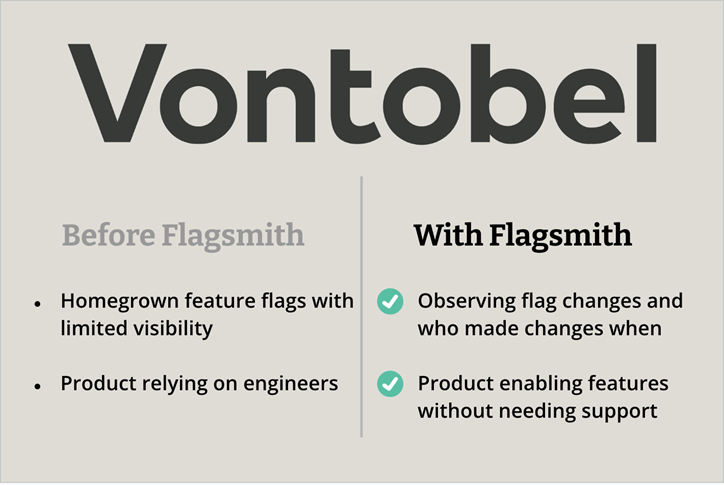
Leading Swiss investment bank Vontobel needed a self-hosted feature flag service that didn’t require a cloud platform.
Its in-house solution lacked the visibility and control their engineering teams needed, leaving them reliant on large overnight deployments to ship new features.
With Flagsmith, the team hides new features behind toggles during development, manages proofs of concept across environments without maintaining separate codebases, and communicates maintenance windows to customers—freeing up product owners to manage flag changes directly.
What is a self-hosted feature flag service?
A feature flag service lets your team toggle features on or off in production without deploying new code. Feature flags, or feature toggles, decouple deployment from release, giving you complete control over who sees what, and when.
Flagsmith is an open-source feature flag and remote config platform with flexible deployment options: self-hosted, private cloud, or SaaS.
Core functionality—including feature flags, remote configuration, user targeting, A/B testing, multivariate flags, and supported SDKs—is available across all options. Try our free tier, with no credit card required.
Ready to take control of your feature flag infrastructure?
With a self-hosted solution, you manage the infrastructure yourself: on-premises or in your own cloud. Our self-hosted hosting option is available as part of our Enterprise plan. As part of our Enterprise plan, Flagsmith provides comprehensive audit logs for granular traceability, allowing you to track every action performed on feature flags. You can learn more here.
Alternatively, you can self-host Flagsmith using our open-source version, which contains our core platform capabilities, but doesn’t include security and management features like SAML, change requests, audit logs, and more.
With Flagsmith’s private cloud option, we manage a dedicated single-tenant instance on your behalf, in your chosen region. Both options keep your data out of a shared environment.
If you choose to self-host via our Enterprise plan, you can start with 20+ seats and unlimited projects. If you self-host via our open-source version, you have access to unlimited seats and 1 project.
No. The open-source version includes core functionality—unlimited feature flags, remote config, server-side SDKs, and basic flag management. The Enterprise plan adds audit logs, role-based access control, SAML/SSO, change requests, and priority enterprise support. If your team needs governance features at scale, Enterprise is the right option.
Self-hosted and private cloud deployments support HIPAA, FedRAMP, and ISO 27001 requirements. Contact our team if you have specific compliance questions.
Yes. The Flagsmith MCP server works with self-hosted deployments, private cloud, and SaaS.
Local evaluation mode allows the Flagsmith SDK to download your flag rules and evaluate them in-process, rather than making a network request to an external service for each evaluation. Flag decisions are faster, there are fewer dependencies on external services, and your feature flag infrastructure is more resilient if connectivity is interrupted.
Yes. You can self-host the open-source version of Flagsmith at no cost. It includes unlimited users, unlimited feature flags, and core functionality across unlimited environments. For security and governance features, the Enterprise plan is available—contact our team for a quote.
We offer three types of deployment:
Self-hosted: Hosted in your own infrastructure, we will support the implementation. Pricing is based on seats and projects, with no API request limits.
Private Cloud: An isolated single-tenant deployment of Flagsmith hosted with your chosen cloud provider in your chosen region, managed by Flagsmith. Pricing is based on seats and monthly API calls.
SaaS: Leverages our Edge API infrastructure and is managed by Flagsmith. Pricing is based on seats and monthly API calls.
Infrastructure + database support
With custom levels of support—from fully managed to second level—Flagsmith can take care of as much or as little of your hosting infrastructure needs as makes sense for your org.
Flagsmith supports Postgres, MySQL and Oracle database engines; additional database support is also available depending on your requirements.
Kubernetes and OpenShift
Your teams can easily deploy Flagsmith’s containerized platform to Kubernetes via Helm, OpenShift, AWS, Azure, or GCP.
Plus, Flagsmith’s OpenShift Operator makes it easy to deploy into OpenShift infrastructure too.